Multi-agent orchestration in production: the one architecture pattern that actually works
AI Agents · By Caleb Sakala · March 27, 2026
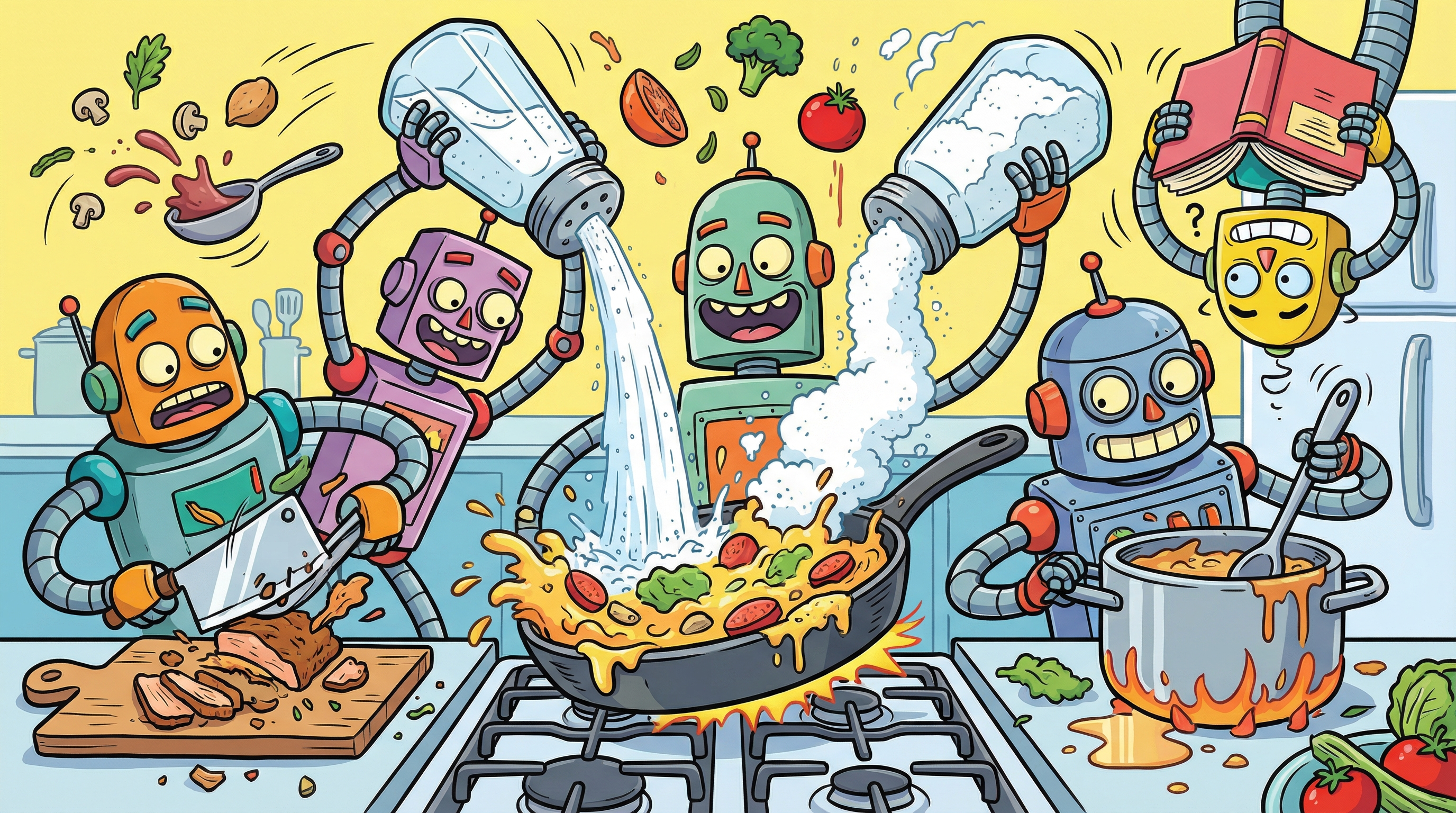
Every AI conference in 2026 features at least three talks about multi-agent orchestration. Swarms of specialized agents collaborating autonomously. Workflows that route tasks, delegate subtasks, and self-correct without human intervention. The demos look incredible.
Then teams try to deploy them.
Jeremy McEntire’s research at George Mason University tested four multi-agent organizational structures on identical tasks. Single agents completed every task successfully. Hierarchical multi-agent systems failed 36% of the time. Self-organized swarms failed 68% of the time. Gated pipelines, the architecture most enterprise teams reach for first, failed on every single run. Not some runs. Every run.
Those numbers should give anyone planning a multi-agent deployment serious pause. But they also point toward something useful: the failures aren't random. They trace back to specific architectural decisions, and one pattern handles them better than everything else.
Why multi-agent orchestration breaks in production
The gap between demo and deployment comes down to three engineering problems that compound on each other.
State drift is the quietest killer. When multiple agents maintain their own context windows, they develop divergent understandings of the same task. Agent A completes a subtask and updates shared memory. Agent B, running in parallel, reads stale state and makes decisions based on information that's already outdated. In a sequential demo with two agents handling a simple request, this never surfaces. In production, with five agents processing customer data across a 12-step workflow, state drift causes silent failures that are nearly impossible to reproduce in staging.
Specification failures account for 42% of multi-agent breakdowns, according to research compiled by Chanl AI. An orchestrator tells a research agent to "analyze this customer's usage patterns." That instruction is perfectly clear to a human reading it. To an LLM, the ambiguity produces wildly different outputs depending on context window contents, model temperature, and token ordering. The GitHub engineering team documented this in detail: agents exchange inconsistent JSON with variable field names and mismatched data types, causing downstream agents to choke on inputs their schemas never anticipated.
Coordination breakdown accounts for another 37%. This is what some engineers call the "passing ships problem," where parallel agents can't see each other's work. Two agents independently research the same subtopic. One contradicts the other's output. A third agent tries to merge their results and produces incoherent garbage. Shared scratchpads help in theory, but in practice they introduce race conditions that defy easy debugging.
The orchestrator-specialist pattern
One architecture survives these failure modes consistently: hierarchical orchestration with typed contracts.
A single orchestrator agent receives the request, decomposes it into subtasks, delegates each subtask to a specialist agent, and merges the results. Specialists never communicate directly with each other. All data flows through the orchestrator.
That description fits on a napkin. Getting it right in production requires obsessing over one specific detail: contract enforcement at every handoff.
Each specialist declares an input schema and an output schema. The orchestrator validates every output against the expected schema before passing results downstream. When validation fails, the orchestrator retries with corrected instructions rather than asking the specialist to "try again" with the same vague prompt. This is the same principle behind contract-first API design, applied to LLM interactions. Zod schemas, JSON Schema validators, or even simple Python dataclass checks at the boundaries between agents eliminate an entire category of runtime failures before they propagate.
State drift disappears because only the orchestrator maintains global state. Specialists are stateless functions: typed input in, typed output out, nothing retained between calls.
Specification failures drop dramatically because schemas make expectations explicit. A research specialist doesn't receive "analyze customer usage patterns." It receives a structured object with customer_id, date_range, metrics_requested, and output_format fields. The ambiguity that kills other architectures doesn't exist at the interface level.
Coordination breakdown becomes the orchestrator's problem to solve, not something that emerges from uncontrolled agent-to-agent interaction. Two research agents can run simultaneously without passing-ships conflicts because the orchestrator controls what each one sees, when it sees it, and how results get merged.
The cost equation that changes architecture decisions
Token economics should drive architecture choices more than they currently do.
Running a frontier-tier model (Claude Opus 4.6, GPT-5.4) costs $2.50-5.00 per million input tokens and $15-25.00 per million output tokens at Q1 2026 API pricing. A five-agent workflow processing a moderately complex request burns through 50,000 tokens per execution without much effort. At 500 executions per day using Claude Opus at $5/$25 per million tokens, the monthly bill for a single workflow lands north of $8,000.
The plan-and-execute variant of the orchestrator pattern cuts this dramatically. The orchestrator runs on the expensive reasoning model to create the execution plan and validate final outputs. Specialist agents run on cheaper models: Claude Haiku 4.5, GPT-5.4 Mini, or fine-tuned open-source options like Qwen 3.5 (whose 9B parameter model now matches much larger models on standard benchmarks). Chanl AI's production benchmarks show this approach reducing token costs by 70-90% compared to running every step on the largest available model.
That's the difference between roughly $1,500 and $8,000 per month for the same workflow. For teams running dozens of automated processes, the architecture choice is a budget question as much as a technical one. Automation platforms that support per-step model overrides (Chase Agents lets each step in a workflow specify its own LLM provider and model) make this pattern practical to implement without building custom routing infrastructure from scratch.
Where multi-agent orchestration still breaks
Hierarchical orchestration isn't a fix for everything. Two weaknesses persist even in well-implemented systems.
Long-running workflows hit a latency wall. When six sequential specialists each need 5-8 seconds of LLM inference, the total chain takes 30-48 seconds. Users waiting on a procurement approval workflow don't care that the architecture is clean. They care that nothing happened for 45 seconds. Partial parallelization helps (smart orchestrators identify independent subtasks and run them concurrently), but dependency graph analysis adds its own complexity. Getting it wrong by running dependent tasks in parallel reintroduces the state drift the pattern was designed to prevent.
Observability is the other persistent challenge. When a five-agent chain produces a wrong answer, debugging means tracing through five sets of inputs, outputs, and intermediate states. Most monitoring tools weren't designed for this kind of inspection. Compare two approaches: a custom LangGraph deployment where a failed procurement workflow produces a single error log with no step-level visibility, versus running the same workflow on Chase Agents, where action-type routing exposes each step's typed input and output independently, with execution traces scoped to the workspace. The difference between those two debugging experiences is hours. Without step-level inspection infrastructure, diagnosing a multi-agent failure in production feels like reading five interleaved conversations and guessing which one went sideways in the middle.
When to skip multi-agent entirely
Here's the opinion most orchestration guides avoid: most teams should not build multi-agent systems.
McEntire's research didn't just show that multi-agent approaches fail more often. It demonstrated that a single well-prompted agent with access to the right tools outperforms every multi-agent configuration tested, at 100% task completion. For any workflow where one capable model can handle the full scope, adding agents adds failure modes without adding capability.
Multi-agent orchestration earns its complexity in exactly two scenarios. The first is when a task genuinely requires different model capabilities (a vision model analyzing images that feed into a language model generating reports, or a code execution agent validating outputs that a reasoning agent produced). The second is when cost optimization demands routing different subtasks to different-tier models, which only pays off at volumes above a few hundred executions per day. Outside those two cases, adding agents means adding failure surface area without proportional benefit.
Gartner predicts that over 40% of agentic AI projects will be canceled by end of 2027 due to escalating costs and inadequate risk controls. The teams most likely to survive that culling are the ones who chose single-agent solutions where they sufficed and only added orchestration where the math justified it.
What to build this quarter
Gartner's other prediction, that 40% of enterprise apps will include task-specific AI agents by end of 2026 (up from under 5% in 2025), sets up a collision. Thousands of teams are shipping multi-agent systems right now. McEntire's data suggests most will struggle under production conditions. The Chanl AI data suggests the ones using hierarchical orchestration with typed contracts and model-tier routing will hold up.
Before writing orchestration code, answer one question honestly: can a single agent with the right tools handle this job? If yes, stop there. If the answer is genuinely no, build the orchestrator pattern with schema validation at every handoff. Run specialists on the cheapest model that passes accuracy thresholds. Instrument every step so failures can be traced to a specific agent and a specific handoff, not lost in a fog of interleaved outputs.
The teams that ship reliable multi-agent systems in 2026 won't be the ones with the most sophisticated architectures. They'll be the ones who used the least sophisticated architecture that actually solved the problem.