AI automation vs RPA in 2026: what operations teams need to know
Industry & Strategy · By Caleb Sakala · March 3, 2026
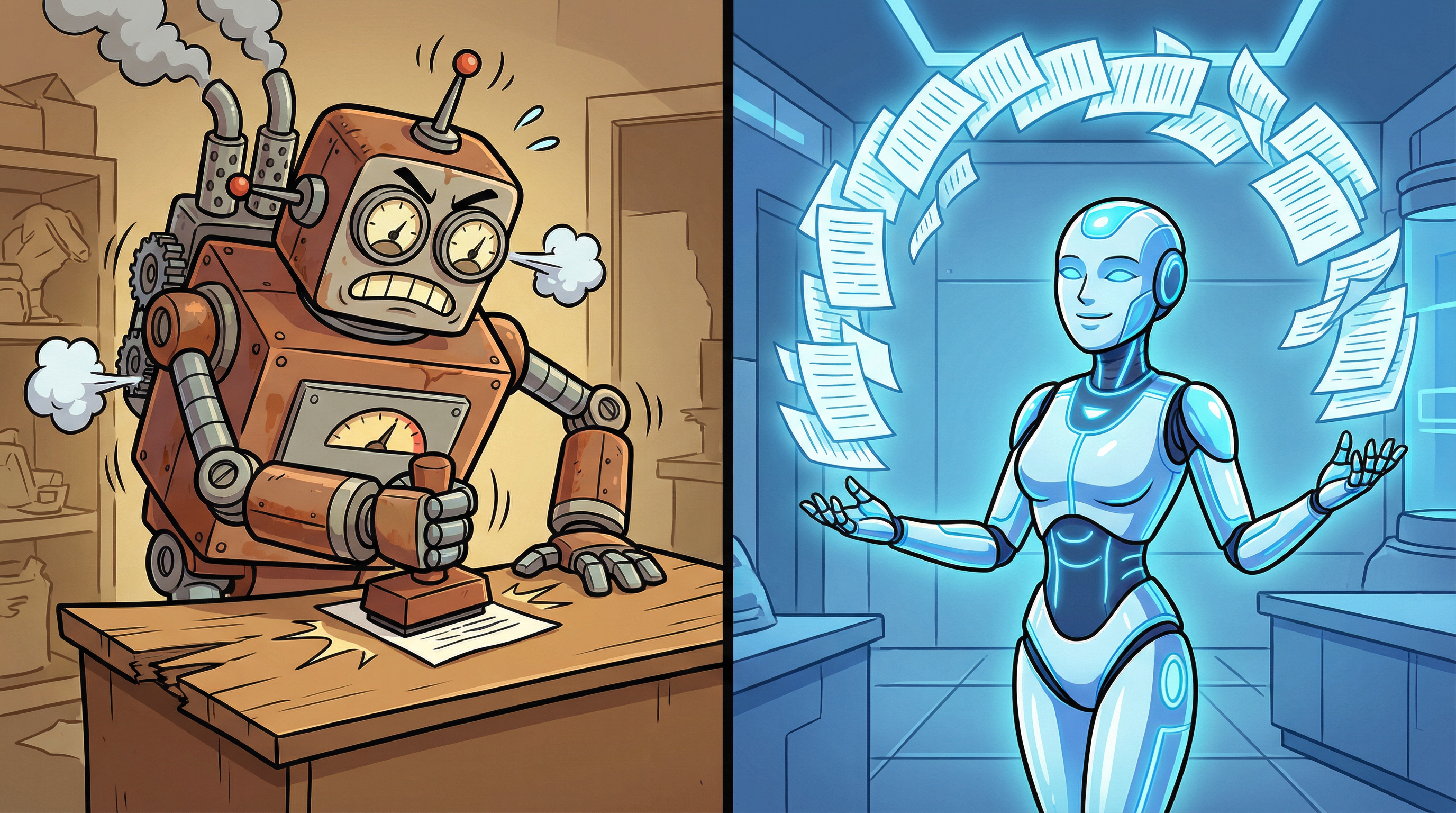
RPA was supposed to fix operations. For a while, it did. Bots ran invoice processing, moved data between systems, filled out forms. The pitch was compelling: automate the repetitive stuff, free up the team for real work.
Then the systems those bots depended on changed. A portal updated its layout. A vendor switched to a new login flow. A field moved two pixels to the left. And the bots broke. Again.
This is the cycle most operations teams know too well. Build the bot, celebrate the efficiency gains, then spend the next six months maintaining it. A 2025 industry analysis found that maintenance tickets exceed 20% of original development effort annually for many RPA deployments. That's not automation. That's trading one kind of manual work for another.
AI automation is a fundamentally different approach to the same problem, and operations teams in 2026 are starting to treat the distinction seriously.
What RPA actually does well
RPA gets a bad reputation now that AI is the new thing, but that's not entirely fair. For structured, predictable processes that don't change often, bots still work fine. Data entry from standardized forms. Moving records between two systems with stable APIs. Running the same report every morning.
The pattern that suits RPA: the input is always formatted the same way, the steps never change, and the systems involved are stable. When those conditions hold, a bot can run thousands of times without failing. Cheap, fast, reliable.
The problem is that very few real business processes actually meet all three conditions for long.
Where RPA breaks down
The brittleness of RPA shows up in three places.
First, UI changes. Most RPA bots interact with applications through the user interface, clicking buttons, reading screen elements, filling fields by position. When the application updates (which happens constantly with cloud software), the bot can't adapt. It just fails. Operations teams then get pulled into maintenance cycles, rebuilding bots around the new layout.
Second, exceptions. A bot follows a script. When something falls outside that script (a missing field, an unexpected format, a new edge case), it stops or produces errors. In most organizations, exception handling ends up being manual anyway, which defeats the purpose.
Third, cross-system workflows. RPA works one application at a time. Orchestrating a process that touches email, a CRM, a spreadsheet, and a shipping platform requires chaining multiple bots together with brittle handoffs between them. Each handoff is a failure point.
What AI automation does differently
AI automation doesn't follow a script. It follows an intent.
Instead of "click this button, then enter this value in that field," AI automation works more like: "Process this invoice. Figure out which vendor it's from, match it to the purchase order, flag anything that doesn't line up, and route it for approval."
The difference matters because AI can handle variation. Different invoice formats. Missing fields that need to be looked up. Vendors that spell their name three different ways across documents. These are the kinds of problems that break RPA bots on day one but that AI handles as part of the normal flow.
AI automation also adapts when systems change. Because it can interpret interfaces, read context, and make decisions about next steps, a portal redesign doesn't automatically mean a broken workflow. The system adjusts.
A CrewAI survey of 500 senior executives found that every single respondent plans to expand AI automation deployments in 2026. The shift isn't coming. It's already happening.
The honest comparison
It's worth being direct about the tradeoffs instead of pretending AI automation is better at everything.
RPA is cheaper to set up for simple tasks. A basic bot can be running in hours. AI automation requires more upfront configuration, especially for complex workflows with multiple decision points. That initial investment pays off over time, but the starting cost is real.
RPA is more predictable. A bot does exactly the same thing every time. That's a weakness when conditions change, but it's a strength when you need absolute consistency. AI introduces probabilistic behavior, meaning the output can vary. For operations teams used to deterministic processes, that requires a different approach to quality control.
AI automation handles complexity better. Anything involving judgment, exceptions, unstructured data, or cross-system coordination is where AI pulls ahead. And the gap widens as the process gets more complex.
The maintenance math is where the decision usually becomes clear. A simple, stable process that runs the same way for years? RPA is fine. A process that touches multiple systems, handles exceptions regularly, or depends on applications that update frequently? AI automation costs less to maintain over 12 months than the bot maintenance would.
Which processes to move first
Operations teams that are evaluating AI automation should start with the workflows that hurt the most under RPA.
Look for bots that break more than twice per quarter due to system changes. Look for processes where exception handling still requires a person to step in. Look for workflows that chain multiple bots across different systems with fragile handoffs.
Those are the highest-ROI candidates for AI automation because the maintenance cost of the current approach is already high. The switch doesn't have to eliminate RPA entirely. The most effective setup treats them as layers: RPA for the stable, simple stuff; AI for the dynamic, exception-heavy stuff.
Start with one workflow. Measure the before and after. Let the numbers make the case for expanding.
What this looks like in practice
A logistics company processing shipping documents from dozens of carriers, each with slightly different formats. Under RPA, every new carrier format means a new bot or a bot update. Under AI automation, the system reads the document, figures out the format, extracts the data, and routes it correctly without custom configuration per carrier.
A BPO handling client onboarding across multiple platforms. The onboarding process touches a CRM, a document management system, an email platform, and a billing tool. Under RPA, that's four separate bots with handoffs between them. Under AI automation, it's one workflow that orchestrates the entire process and handles the exceptions that come up along the way.
These aren't hypothetical scenarios. They're the kinds of workflows that operations teams deal with every day, and they're the ones where AI automation makes the biggest difference.
The bottom line
RPA isn't dead. It still works fine for simple, stable, repetitive tasks. But most real operations workflows aren't simple or stable. They involve multiple systems, messy data, frequent exceptions, and constant change.
AI automation handles that reality better. Not because it's newer or more expensive, but because it was built for the kind of work that operations teams actually do.
The question isn't whether to switch from RPA to AI. It's which workflows to move first. Start with the ones that keep breaking.
Frequently asked questions
Is RPA still worth investing in?
For simple, stable processes that don't change often, yes. Data entry from standardized forms, basic report generation, and straightforward data transfers between stable systems are all fine RPA use cases. The problems start when processes involve exceptions, multiple systems, or applications that update regularly.
How much does AI automation cost compared to RPA?
Setup costs are typically higher for AI automation, especially for complex workflows. But maintenance costs are significantly lower. Over a 12-month period, many operations teams find that AI automation is cheaper overall because they're not constantly rebuilding broken bots.
Can AI automation and RPA work together?
Yes, and that's the approach most teams are taking. RPA handles the stable, predictable layer. AI handles the dynamic, exception-heavy layer. The two complement each other rather than competing. Platforms like Chase Agents make it possible to orchestrate both within the same workflow.
Where should operations teams start?
Start with the workflow that causes the most maintenance headaches. If a bot breaks regularly, if exceptions require constant human intervention, or if the process touches multiple systems with fragile handoffs, that's the strongest candidate for AI automation. Measure the results before expanding.