Most teams pick an AI agent framework for the wrong reason
AI Agents · By Caleb Sakala · April 21, 2026
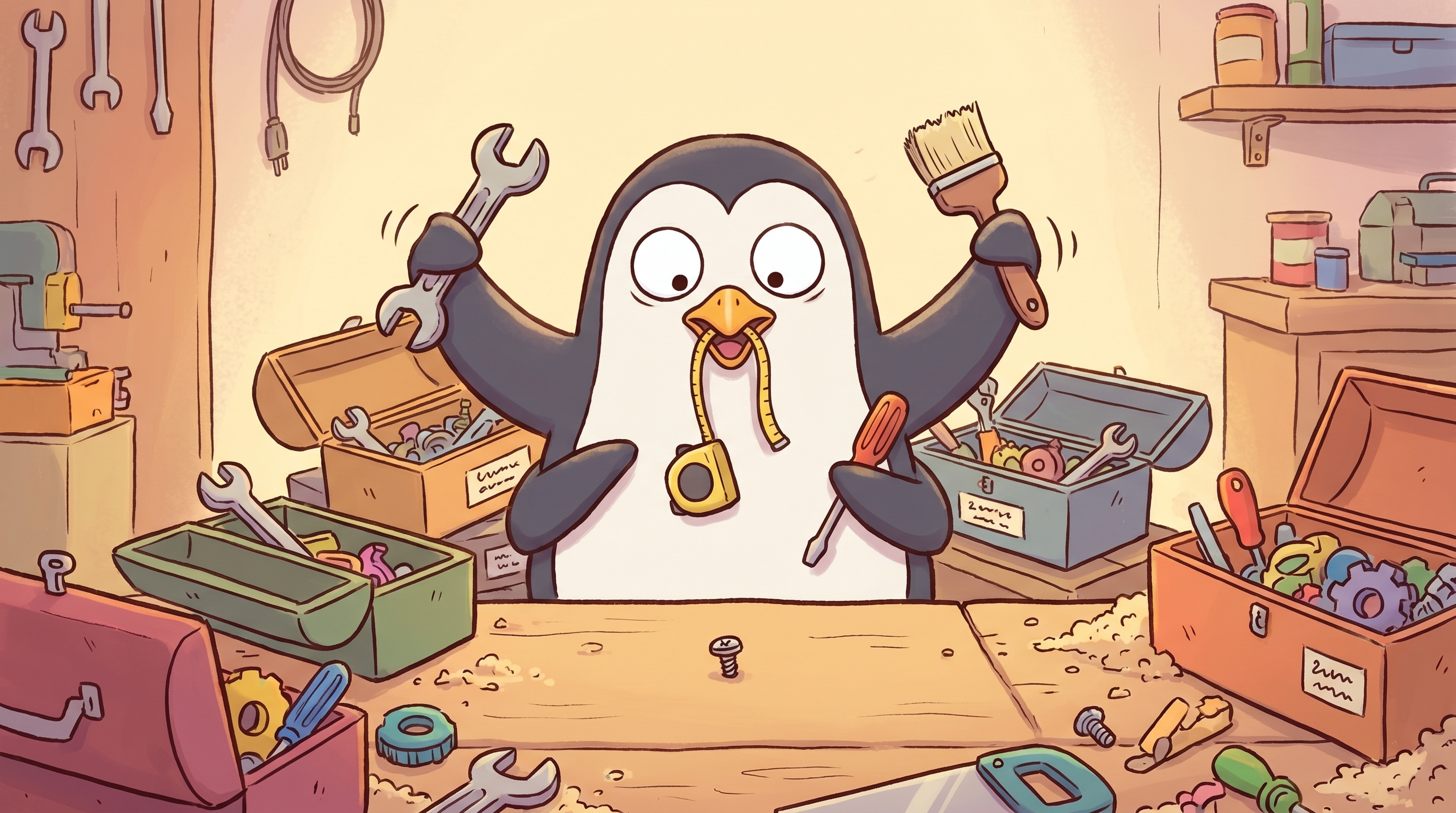
You spent a week evaluating CrewAI against LangGraph against AutoGen. You read the comparison posts — all ten of them, all saying roughly the same thing. You ran the quickstart tutorials. You picked one, built a proof of concept, showed it to stakeholders, and got budget to ship.
Four months later, your team is debugging framework internals instead of building product features.
This is the part the comparison articles skip. There are at least 40 AI agent frameworks available right now. The listicles rank them. Nobody talks about what happens after you commit.
Frameworks solve the demo, not the deploy
Every AI agent framework promises the same thing: abstractions over orchestration, memory management, tool integration, and state tracking. Those are real problems, and frameworks do solve them — for the first three weeks.
The trouble starts when your use case diverges from the quickstart. You need a custom memory backend. Your tool schema doesn’t fit the framework’s expected format. You want to swap model providers mid-workflow because GPT-4o is cheaper for classification but Claude handles long-context extraction better. Suddenly you’re reading framework source code on GitHub at 10pm, looking for an escape hatch that may not exist.
According to Gartner’s Q1 2026 data, LangGraph appeared in 34% of production architecture documents at enterprises with 1,000+ employees. That’s impressive adoption. What the stat doesn’t capture: how many of those teams are actively fighting the framework instead of building on it.
The abstraction tax is measurable
Here’s what a basic tool call looks like when you call an LLM API directly versus through a typical AI agent framework:
# Direct API call: 14 lines, zero framework dependencies
import anthropic

client = anthropic.Anthropic()
response = client.messages.create(
    model="claude-sonnet-4-6",
    max_tokens=1024,
    tools=[{"name": "get_invoice", "description": "Fetch invoice by ID",
            "input_schema": {"type": "object", "properties": {"id": {"type": "string"}}}}],
    messages=[{"role": "user", "content": "Pull invoice INV-4821"}]
)
# Handle tool call, send result back. You control every step.
Through a framework, that same call passes through an agent executor, a tool registry, a prompt template engine, a memory layer, and an output parser. Each layer adds latency, each layer is a surface for bugs, and each layer is a dependency you’ll need to update when the framework ships a breaking change.
Temporal’s engineering team published numbers on this: at 85% per-step accuracy, a 10-step agentic workflow succeeds end-to-end about 20% of the time. Adding framework abstraction layers doesn’t improve per-step accuracy. It adds steps. A framework that silently retries a failed tool call or injects a memory-retrieval step is increasing your chain length without telling you.
The cost math works out the same way. If you’re running Claude Sonnet at $3 per million input tokens and your framework adds a system prompt, memory context, and chain-of-thought wrapper to every call, you’re looking at 30-60% token overhead per invocation. On 50,000 agent runs per month at an average 2,000 tokens per call, that’s an extra $90-$180/month in raw API costs — just from the framework’s own prompting. Small on paper, painful at scale.
Where this breaks down in production
Three sharp edges that don’t show up in tutorials.
First, version upgrades. LangChain shipped over 400 releases in 2024 and 2025 combined. Each one can break your agent’s behavior in ways that don’t surface until a customer hits the edge case. If your agent depends on a specific prompt-chaining behavior that the framework changed in a minor release, you’re debugging framework internals, not your product.
Second, model lock-in by accident. Most frameworks default to OpenAI. Switching to Anthropic or Gemini is technically supported but practically painful — different function-calling conventions, different streaming behaviors, different token counting. You built “model-agnostic” on paper. In reality, you built OpenAI-specific code wrapped in a framework that pretends otherwise.
Third, memory abstractions that don’t match your data. Framework memory stores are generic. Your production system has domain-specific context: customer IDs, conversation threading, compliance metadata. Mapping your data model onto a framework’s memory interface means either losing fidelity or building a custom adapter that defeats the purpose of using the framework.
The question the listicles won’t ask you
The right question isn’t “which AI agent framework should I pick.” It’s whether your workflow actually needs one.
Look at what you’re building. If it’s a deterministic sequence — receive webhook, classify input, query database, generate response, send notification — that’s a workflow, not an agent. Wrapping it in an agentic framework adds moving parts without adding capability. You wanted reliable execution. You got an inference loop.
This is where most teams end up anyway. The UC Berkeley study from December 2025 found that 92.5% of production agents deliver output to a human for review rather than taking action autonomously. The “agent” is functioning as a draft generator inside a human-supervised workflow.
Chase Agents takes the opposite approach. Instead of making you express your workflow inside a framework’s abstraction, each automation step declares its inputs, outputs, and which tools it can access. The platform routes by action type: an AI classification step and a database query step are structurally different, with tool access granted or withheld at each boundary. No framework runtime sits between your logic and the model. When you need to swap Claude for GPT-4o on a specific step, you change the model on that step. Nothing else moves.
Eighteen months from now
The AI agent framework market will consolidate hard. Cloud providers are already absorbing frameworks into managed services — Google’s ADK, AWS’s Strands Agents, Microsoft’s merger of AutoGen and Semantic Kernel. The standalone frameworks that survive will be the ones that treat themselves as scaffolding you can remove, not load-bearing walls.
If you’re choosing a framework today, pick the one with the clearest ejection path. The one where your business logic lives in your code, not in the framework’s abstractions. Because the framework you choose in April 2026 probably won’t be the one you’re running in October 2027.
The demo always works. What matters is what you’re debugging six months later.
Sources: Gartner Q1 2026 production architecture data (34% LangGraph enterprise adoption) via chatbot.com. Temporal.io per-step reliability analysis (85% accuracy → 20% end-to-end success at 10 steps). UC Berkeley “Measuring Agents in Production” study, December 2025 (300+ teams, 92.5% human-in-the-loop). LangChain release cadence tracked via GitHub. Anthropic Claude Sonnet pricing via anthropic.com, April 2026.